
I am staunchly against AI generated images for a wide plethora of reasons, chiefly among them: destruction of the environment, and theft of every type of art ever created by nearly everyone whom has ever created anything publicly, ever, anywhere.
So saying. I am not here to shame anyone using it.
Keeping this post productive, I am going to list out a few of the literal infinite things you can use for imagery instead of generative AI.
I am not an art cop, nor an avenging art god. You may use this information, or not, at your own profit or peril.
This post is meant as a public service message.
01. Public domain imagery: no rights reserved
Your country's rules will almost certainly vary, but generally speaking, there is going to be an almost unbelievably large amount of public domain imagery available.

I combined 3 public domain images and added some text. Instant banner.
You will frequently find browsable archives from museums, libraries, and universities. Given the nature -- copyright has expired and/or been abandoned -- it can be used, mixed, re-used, re-mixed, into anything and everything you want, for free, forever.
02. Creative Commons: some rights reserved
One of the most magnificent aspects of modern art and imagery life is Creative Commons. A wide swath of people whom make stuff expressly want to share it with people whom want to make other stuff.
Sometimes they want a link or a note of credit. Sometimes they say it can be used, but not altered. There are a lot of paths and boundaries, all of which can be fairly easily parsed when you browse a CC archive.
The usage requirements shift slightly, but the core idea is the same as public domain: imagery you do not pay for that you can use.
03. Scrap paper and pens, markers, pencils
If we can avoid splitting hairs a bit (this point and the next few items are not free, per the title of this post, because you had to buy them at some point), use scrap paper and writing materials you have handy.
If you do not know how to draw, then draw with objective low quality and obvious enjoyment and cleverness.
Maybe literally draw stick figures.

Slab Graveyard, via xkcd, one of the internet's most popular comic strips.
As a fun side note, combining this with the point before it, usage of this xkcd comic is free under a Creative Commons license!
04. Your smart phone camera
You (probably) have a phone and it (very likely) has a camera. This means photos you take can be used for your own material.
Taking a photo of copywritten material is more of a gray area than I can advise in a public blog post, as I am not your lawyer and you are not my client in any capacity, but if you take a photo of something that is public?

Or of your own creation? Fair game!

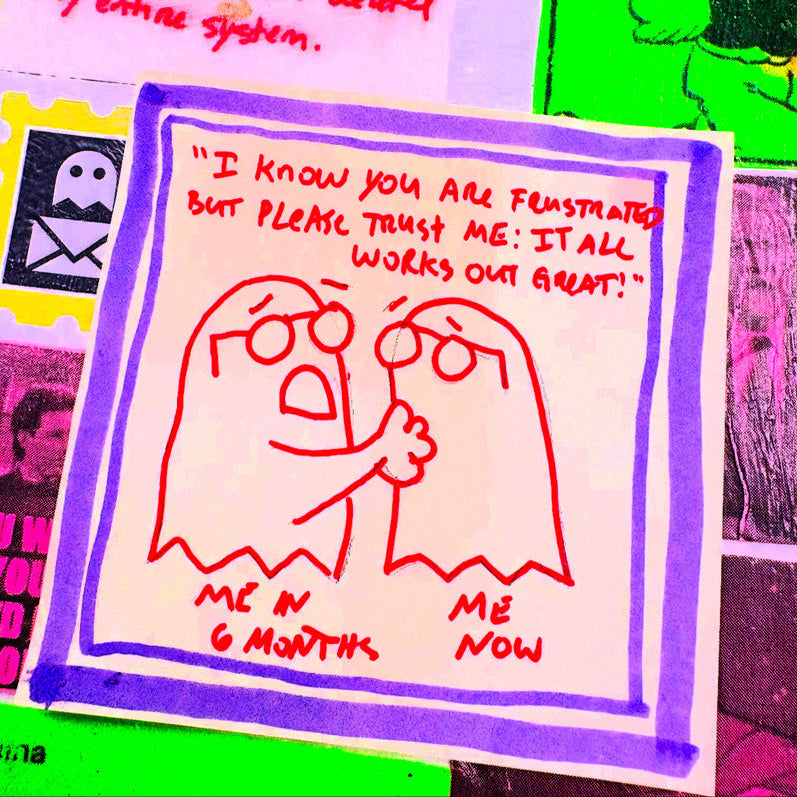
This is a post-it note I doodled on and shot with my phone. All image editing and filters were completed with the default "photos" app -- I did not use any of the ten trillion photo filter apps available.
- I drew it
- Knelt low, put my camera close to the post it
- Took a photograph
- Spent 5 minutes editing the colors because I'd spent 0 minutes adjusting the lighting to prove a point
- Uploaded it here
There are a lot of ways this image could be improved. It's also at least fine as-is to use as a blog header.
Pretty decent photography can be learned in about an hour and pretty good photography can be learned in a lazy weekend. At least 50% of the process is simply taking a bunch of photos with different angles, lighting, and settings, looking at the results, and keep going when you like what you see.
You are not taking photos for a wedding, in a war zone, or in some other once-in-a-lifetime opportunity where split seconds count and reputations (and possibly lives) are on the line.
You can become more competent than your goals will find necessary in photography with your phone and a handful of days of practice.

Honestly, the same thing can be said about drawing: you can become more competent than your goals will find necessary with drawing with a handful of days of practice.
If you are not selling photography or drawing, the barrier for "this is what I need" is extremely low.
The most important criteria is novelty. Arguably, unless you are expressly selling the image as a product or service, the only criteria needed to be a successful image is novelty. You need an image that, at the same time, says
- THIS IS WHAT MY WIDGET IS ABOUT
- As well as I PERSONALLY MADE THIS IMAGE ABOUT MY WIDGET.
05. Just make something. Keep it simple, make it neat.
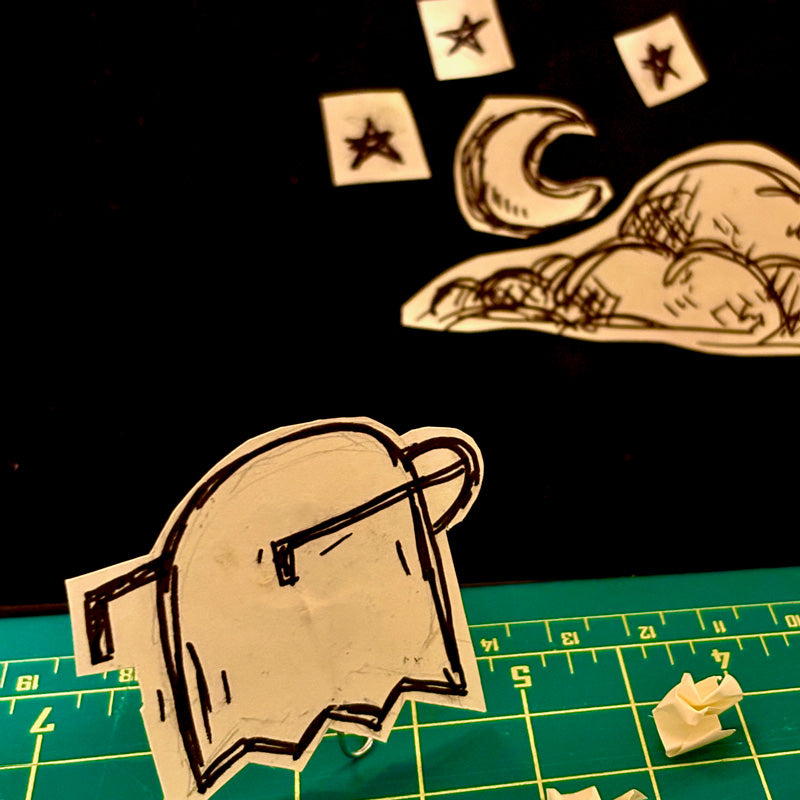
As a more advanced, yet still accessible, study on how to apply these concepts, I made the main image for this blog post with a few scraps of paper, a pen, an old ipad, a green cutting board background, tape, and a paperclip.

I'm already dreaming up new ways to incorporate doodles, cut paper, and smart phone photography. This will be a neat way to create blog headers when I don't want to draw or paint something.
To stay in the spirit of this post, I used the default camera app to take the photo and all edits used my phone's default photo album app.

Rather than learning how to make better prompts, you can learn how to make better imagery.
The internet, as well as your local library, is full of countless tutorials, instruction books, and portfolios that will make you very quickly say "damn, I wish I'd thought of that!"
Good news!
You may not have thought of it first, but you can adapt the technique into something you did think of, experiment with, and produce. It will take a little bit of time, and a little bit of practice, but the result will give you something unique to the larger thing you are making.
Generative AI feels like a branding and graphic design agency in a box. It provides the illusion of control and customization, when the reality of the situation is far more bland and banal.
- You are provided something
- You did not make it
- You are going to blend into a sea of sameness
Objectively, it might not be immediately worthless, but it won't be long before everything has the same core structure, attributes, details, and the uniqueness you were attempting to achive is gone in a manner quieter than you expected and faster than you will know how to prevent.

A scrap wood decorated with white ink marker on a cutting mat I had handy. I took the photo with my phone, used a free app to filter the colors slightly.
And if none of this convinces you to at least try to make your own work, I wish to end with this chilling prediction, built on a long career in the "making things for the internet" industry.
As of writing (autumn 2026), many of the image generators are free. The largest tech companies on earth are making their own as part of a larger AI push. These will be free... until the programs are quietly sunset when they become too expensive to run.
Every other generator, built by the AI-first companies, will someday find themselves at the behest of pissed off and impatient shareholders whom demand the model move from "free" to "cheap" to "suddenly very expensive."
Good luck!
You can avoid all of this by simply creating your own work.
You do not have to listen to me. I am not your boss.
But if you use generative AI imagery, I'll also not be your customer.